Here’s the concise list for those of you who just want the bottom line. For those who like more detail and want to know what to expect, see the descriptions below.
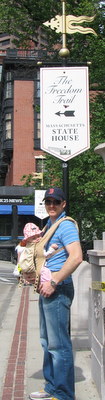
- The Boston Common
- The State House
- Park Street Church
- Granary Burying Ground
- King’s Chapel & King’s Chapel Burying Ground
- Benjamin Franklin Statue/Boston Latin School
- Old Corner Book Store
- Old South Meeting House
- Old State House
- Site of the Boston Massacre
- Faneuil Hall
- Paul Revere House
- The Old North Church
- Copp’s Hill Burying Ground
- Bunker Hill Monument
- USS Constitution
There are at least six guided tour options for your Freedom Trail walk. Each has a slightly different angle, but they all last about 90-minutes (if you are interested in Freedom Trail Boston hours) and cover the majority of the the historic Freedom Trail sites.
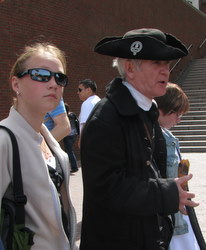
- Walk Into History – The Freedom Trail Foundation
- Free Tours By Foot
- Boston National Historical Park
- Boston By Foot
These guys also offer a 1-hour tour aimed at kids aged 6-12. - The Path to Independence – The Histrionic Academy
- Boston Adventures Scavenger Hunts
2. The State House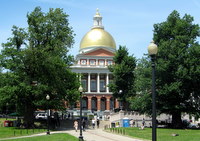 Beacon Street at Park Street
Completed in 1798, the Massachusetts State House, or “New State House,” is one of the oldest buildings on Beacon Hill. It’s easily recognizable and, with its huge gold dome, it serves as a very helpful visual reference point.
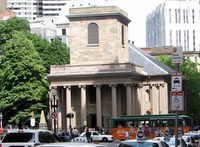
8. Old South Meeting House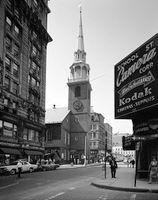 310 Washington Street
Sometimes referred to as ‘The Sanctuary of Freedom’, the Old South Meeting House played host to pivotal events in the birth of the United States. In fact, the meeting held on December 16, 1773 is assumed to have been the trigger for the famous Boston Tea Party which took place later that night.
9. Old State House
Intersection of Devonshire & State Streets
The British Government ruled the colony from here until they were driven out by the Continental Army. The balcony on the east side of the building is where the Declaration of Independence was read to the people of Boston.
10. Site of the Boston Massacre
Intersection of Devonshire & State Streets
In front of the Old State House you’ll find a circle of cobblestones marking the site of the Boston Massacre. Five Bostonians were killed here by British soldiers on March 5th, 1770. As a result, what had started as a small fight became a significant step towards the American Revolution.
11. Faneuil Hall & Sam Adams Statue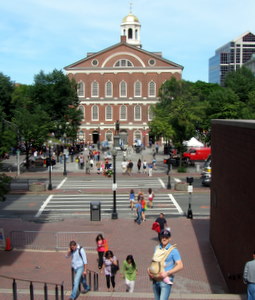 North Market Street
Faneuil Hall was built in 1742 as a center of commerce. The first floor market stalls are still a great shopping experience today and the third floor is the HQ for the third oldest chartered military organization in the world, the Ancient and Honorable Artillery Company of Massachusetts.
The reason it is sometimes referred to as the Cradle of Liberty is because of the meeting hall on the second floor. What about it? Starting in 1764, Faneuil Hall was the site of public protests against various taxes and the Redcoat occupation. In addition, the first meeting (of many) that led to the Boston Tea Party was held here.
The Samuel Adams statue is in front of Faneuil Hall. Adams’ speeches in and around this building, strongly encouraged independence from Great Britain. He also staged a funeral here for the Boston Massacre victims.
12. Paul Revere House
19 North Square
A house with serious history… The Paul Revere House is the oldest building still standing in downtown Boston. Revere set out from here on his famous Midnight Ride to Lexington.
13. The Old North Church
193 Salem Street
Ever heard Henry Wadsworth Longfellow’s famous poem “Paul Revere’s Ride,” which gave rise to the phrase “One if by land, two if by sea”? Well, this is the source of it. On April 18, 1775, two lanterns were hung in the 191-foot steeple of the Old North Church to alert the surrounding areas that the Redcoats were coming.
Old North Church is officially known as Christ Church in the City of Boston. It’s the oldest standing church building in Boston and is today an active Episcopal church.
14. Copp’s Hill Burying Ground
Hull Street
William Copp was a shoemaker who once owned this land. It was founded as a burying ground in 1659 by the town of Boston and is the city’s second oldest graveyard.
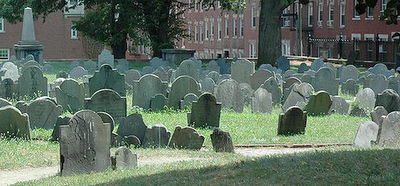
Among those buried here are William Copp and his children, Robert Newman (sexton of Old North Church, and believed to be the person who hung the two lanterns on the night of Paul Revere’s midnight ride), Increase Mather and Cotton Mather (of the Salem Witch trials), Prince Hall (the father of Black Freemasonry) and Edmund Hartt, builder of the USS Constitution. In addition, up to 1,000 free African-Americans are buried here in unmarked graves.
Copp’s Hill was the obvious place for the British to position their cannons during the Battle of Bunker Hill. Due to it being the third highest hill in Boston, it gave an easy aim to many surrounding areas, including Charlestown.
15. Bunker Hill Monument
Monument Square, Charlestown
Technically the British forces won the Battle of Bunker Hill. However, the Bunker Hill Monument commemorates the incredible determination of the colonial forces during this, the first major battle of the Revolutionary War.
On June 17, 1775, on this site, a relatively small and newly-formed patriot army held off 2,200 British troops until a third wave attack finally forced surrender of the hill. With ammunition supplies dwindling, the famous order was given by a colonial Commander… “Don’t fire until you see the whites of their eyes.” The end result was over 1,000 British casualties, compared to 400-600 colonial casualties. This proved the effective fighting capabilities and resolve of the colonial forces.
16. USS Constitution (“Old Ironsides”) and Museum
Charlestown Navy Yard
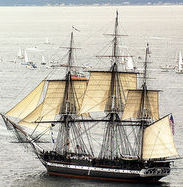 “Old Ironsides” is the famous nickname given to the naval vessel USS Constitution. The name was earned during the Second War of Independence when cannonballs fired by the British simply bounced off her sides. Old Ironsides is the oldest commissioned warship still afloat anywhere in the world.
Free guided tours of the ship are given by active-duty Navy sailors. The tours include three decks of the ship and reveal USS Constitution’s history to the current day. One tip: Security screening is required for all visitors, so take that into account when planning your visit.
Save up to 50% on Boston's best activities, tours, and attractions with the Go City® Boston Pass

